

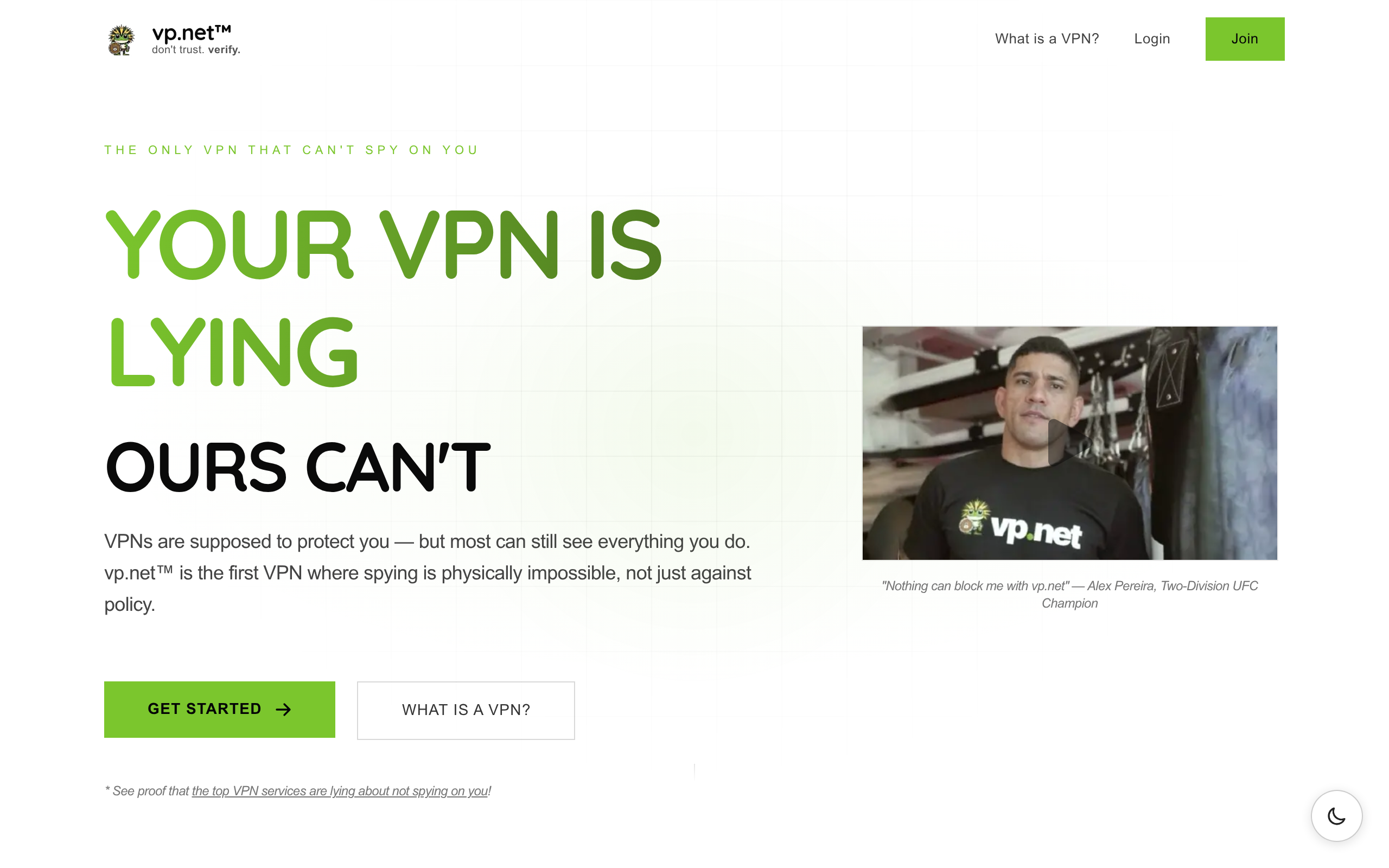
VP.NET is the first VPN where spying is physically impossible, not just against policy. Powered by a patent-pending split architecture, it uses Intel SGX hardware enclaves to create a cryptographically verifiable privacy barrier.
Key Features
-
Hardware-Sealed Processing — Your traffic is processed inside Intel SGX secure enclaves that even the service administrators cannot access. Not with root access, not with physical access.
-
Zero-Knowledge Architecture — The mapping between your real identity and your VPN traffic never exists outside the enclave. There is literally no data to log, subpoena, or hand over.
-
Cryptographic Attestation — Real-time cryptographic proof that the privacy protections are running on genuine Intel SGX hardware, independently verifiable by anyone.
-
Identity-Traffic Separation — A triple-layered cryptographic mixing system completely breaks the link between who you are and what sites you visit, using ephemeral session IDs and batched request mixing.
-
WireGuard Compatibility — Works with standard WireGuard clients across Windows, macOS, Linux, iOS, and Android.
-
Censorship Circumvention — Every subscription includes Dissent, a censorship-proof VPN whose traffic looks like ordinary web browsing, working even where VPNs are blocked.
-
No Limits, No Throttling — Unlimited bandwidth with optimized routing for minimal latency.
-
Modern Cryptography — ChaCha20 encryption, Poly1305 authentication, Curve25519 key exchange, and BLAKE2s hashing with perfect forward secrecy through automatic key rotation.
Pros
- Hardware-enforced Intel SGX enclaves make user surveillance physically impossible — even server administrators cannot access traffic inside the protected memory regions.
- Cryptographic attestation provides real-time, independently verifiable proof that the correct unmodified code is running inside a genuine Intel SGX enclave.
- Every subscription includes Dissent — a censorship-proof VPN that disguises traffic as ordinary web browsing to work even where standard VPNs are blocked.
- Founded by Andrew Lee, creator of Private Internet Access (PIA), bringing decades of experience in cryptography and privacy engineering.
- SGX enclave source code is fully open-source on GitHub, enabling anyone to independently verify the server code by comparing deterministic cryptographic hashes.
- Zero-knowledge triple-layered identity mixing permanently separates user identity from browsing destinations using ephemeral session and route IDs.
Cons
- No router or WireGuard client support yet, limiting use for home network protection despite being built on the WireGuard protocol.
- Team includes controversial figures Mark Karpelès (former Mt. Gox CEO) and Roger Ver, raising trust concerns among some privacy-conscious users.
- Lacks common VPN features such as split tunneling, port forwarding, and built-in ad/tracker blocking found in competing services.
- Only 5 simultaneous connections per account, which is lower than the 8–10+ offered by many leading VPN providers.
- Very limited server network with only 6 locations across 3 continents (US, Europe, Japan), far fewer than established competitors.
- Relies on Intel SGX technology which has documented security vulnerabilities and side-channel attacks that have been patched multiple times.