

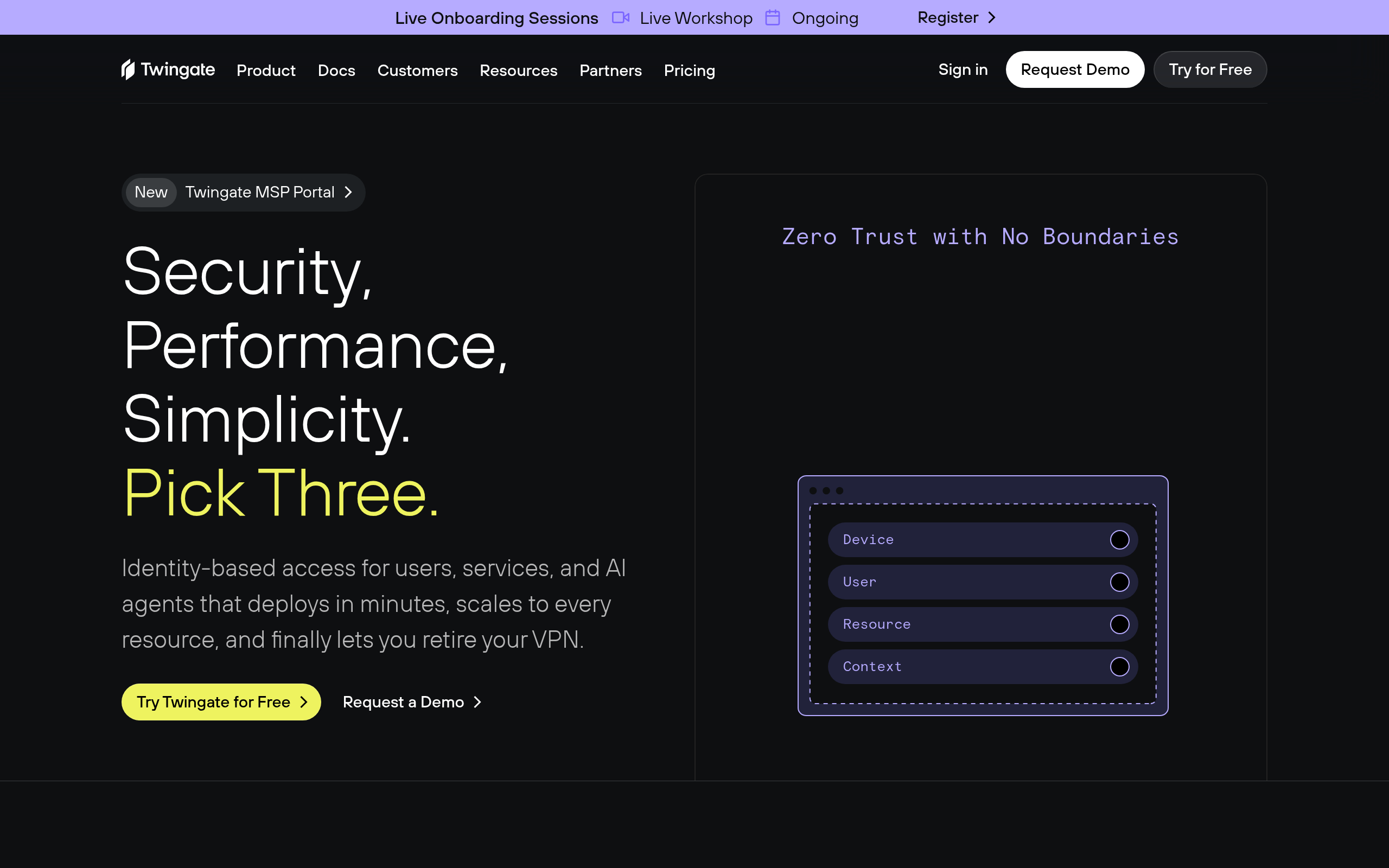
Twingate is a modern Zero Trust Network Access (ZTNA) solution designed to replace legacy VPNs with a secure, high-performance, and easy-to-manage remote access platform.
Purpose
Twingate enables organizations to provide employees, contractors, and AI agents with secure access to private resources — whether in office networks, cloud VPCs, or hybrid environments — without exposing any attack surface. It eliminates open inbound ports and lateral network traffic, making every connection inherently more secure.
Key Features
-
Identity-Based Access: Leverages native integrations with major identity providers (Okta, Azure AD, Google Workspace, OneLogin, JumpCloud) to authenticate users and sync groups via SCIM provisioning.
-
Granular Least-Privilege Policies: Define access controls at the protocol and port level per resource. Apply rules based on user identity, group membership, device posture, and context.
-
Device Posture Checking: Integrates with MDM/EDR solutions (CrowdStrike, Intune, Kandji, Jamf) to enforce device security requirements — encryption, firewall, antivirus — before granting access.
-
Universal MFA: Apply TOTP, biometric, and security key-based multi-factor authentication to any resource, including SSH and RDP connections.
-
Zero Trust as Code: API-first design with first-class support for Terraform and Pulumi, enabling DevOps teams to manage access controls programmatically as part of their infrastructure-as-code workflows.
-
Direct Peer-to-Peer Connectivity: No traffic bottlenecks or tunnels. Clients connect directly to resources for maximum performance with minimal latency.
Use Cases
- VPN replacement for remote workforce access
- Secure access to cloud VPCs (AWS, GCP, Azure) and Kubernetes clusters
- Least-privilege access for contractors and third-party vendors
- Privileged access management for production infrastructure
- Internet security with DNS filtering, content filtering, and threat intelligence
Pros
- Deploys in minutes without network reconfiguration and requires no open inbound ports, eliminating the traditional VPN attack surface.
- Uses direct peer-to-peer connectivity with split tunneling so business traffic is encrypted while personal traffic bypasses the tunnel for minimal latency.
- Integrates natively with major identity providers (Okta, Azure AD, Google Workspace) and MDM/EDR solutions (CrowdStrike, Intune, Kandji, Jamf) for device posture enforcement.
- Supports Zero Trust as Code with first-class Terraform and Pulumi providers and a comprehensive API for programmatic access policy management.
- Offers granular least-privilege access controls at the protocol and port level per resource, based on user identity, group membership, and device posture.
Cons
- Lacks native support for Windows Server, which limits deployment in environments that rely on Windows Server infrastructure.
- Customer support is limited to ticketing, messaging, and email with no 24/7 live chat or phone support outside of Enterprise plans.
- Headquartered in the United States (a Five Eyes member), and collects analytics and diagnostic data that may raise privacy concerns for some organizations.
- Initial setup requires higher-level IT knowledge, particularly deploying connectors via command-line tools like Docker, Helm, or Azure CLI.
- Lacks a traditional VPN kill switch and does not support port-level access, which may be needed for certain compliance or workflow requirements.