
Description
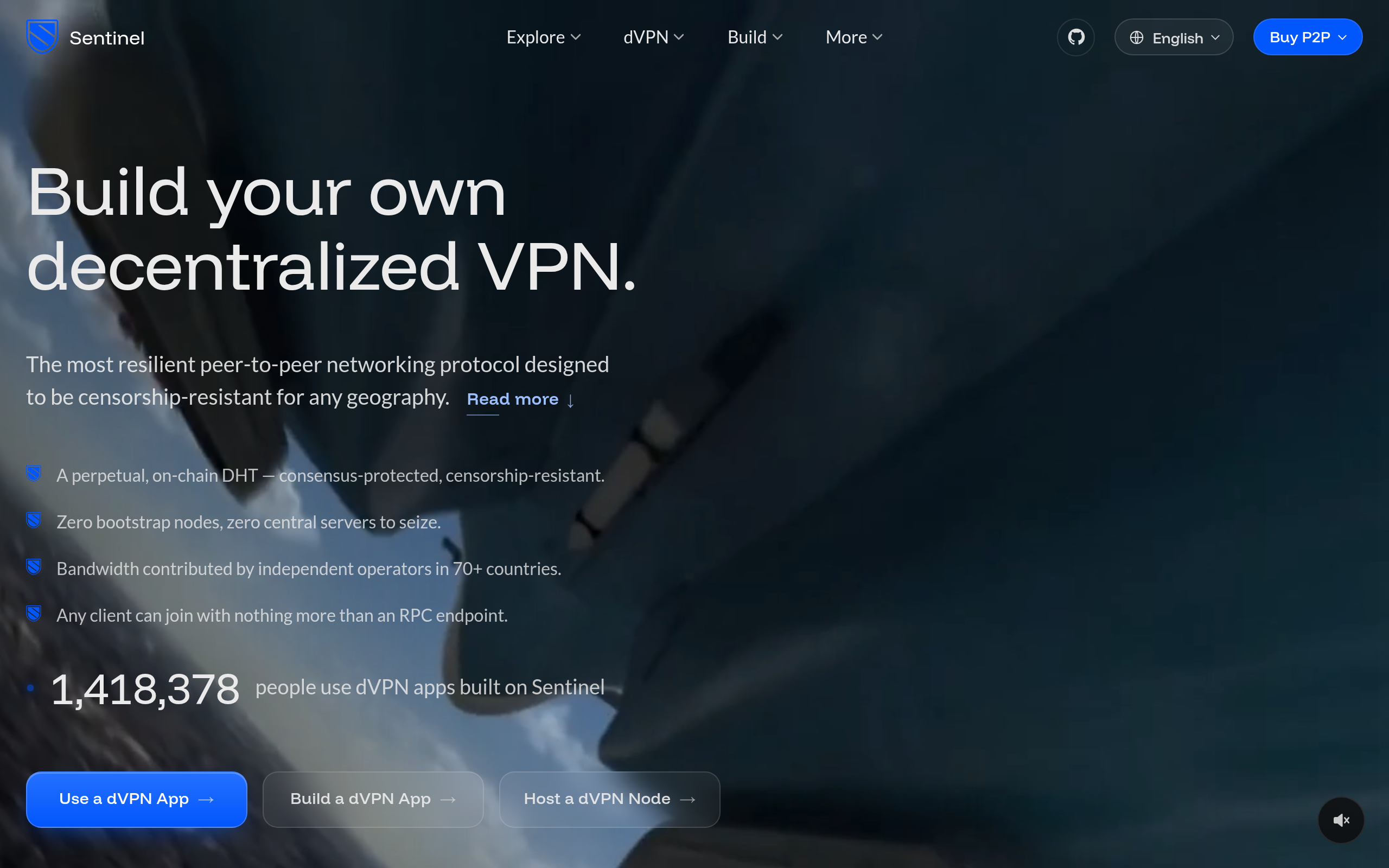
Sentinel is a decentralized VPN protocol built on the Cosmos SDK that enables anyone to build, host, or use censorship-resistant VPN applications. Unlike centralized VPNs, Sentinel has no single entity controlling servers, keys, or logs — the blockchain itself serves as the backend.
Key Features:
- 1500+ Nodes Across 70+ Countries — bandwidth contributed by independent operators; no central servers to seize
- WireGuard & V2Ray Protocols — kernel-fast encrypted tunnels with anti-censorship capabilities
- On-Chain Session Authorization — every session is a signed, immutable transaction on the blockchain
- Open Source Stack — every layer (SDKs, protocol, chain, node software) is fully auditable on GitHub
- 8+ dApps Built on Sentinel — including Sentinel Shield, Independent VPN, Ryn VPN, and DVPN by NORSE, serving 1.4M+ users
- x402 Payments for AI Agents — autonomous VPN access for AI agents, paid in USDC with no API keys needed
Use Cases:
- Build white-label dVPN apps using the Sentinel SDKs (JavaScript, C#, Go, Swift)
- Host a dVPN node and earn bandwidth rewards
- Access censorship-free internet from any client with an RPC endpoint
- Provide autonomous VPN connectivity for AI agents via the x402 payment protocol
Highlights
Pros
- No central point of failure or censorship — discovery is on-chain via the Cosmos SDK, there are zero bootstrap nodes or central servers to seize, and the network continues running even if the founding organization disappears.
- Supports both WireGuard (Curve25519) and V2Ray (VMess/VLESS) protocols — offering kernel-fast encrypted tunnels alongside anti-censorship capabilities for restrictive networks.
- Fully open-source at every layer — the chain, protocol, node software, and client SDKs (JavaScript, C#, Go, Swift) are all publicly auditable on GitHub with over 41,000 lines of open code.
- 1,500+ independent node operators across 70+ countries — bandwidth is provided by residential and independent hosts rather than datacenter servers, making nodes hard to identify and block.
- 8+ dApps built on the protocol serving 1.4M+ users — including Sentinel Shield, Independent VPN, Ryn VPN, DVPN by NORSE, Meile VPN, and VALT, demonstrating real-world adoption and choices for end users.
Cons
- Requires acquiring DVPN cryptocurrency tokens to pay for bandwidth — creating a barrier for non-crypto users who must buy tokens from exchanges and manage wallets before using the service.
- Ecosystem is complex and fragmented — users must navigate multiple whitelabel apps, crypto wallets, staking mechanics, and a 28-day unbonding period, making it far less straightforward than a traditional VPN service.
- Risk of malicious node operators — because anyone can run a node, the decentralized model admits the possibility of bad actors or malicious nodes handling user traffic, as acknowledged in Sentinel's own GitHub documentation.
- Some dVPN apps suffer from wallet and connectivity bugs — App Store reviews for Sentinel Shield report wallet creation errors and connection failures, indicating stability issues in the user-facing applications.
- Node quality and reliability are inconsistent — GitHub issues document connection timeouts, DNS resolution failures, and certain sites being inaccessible depending on which community-run node is used.