

Description
Overview
ProtonVPN is a high-speed, privacy-first VPN service developed by Proton AG (the team behind Proton Mail). Founded in 2014 by scientists from CERN and MIT, it is headquartered in Switzerland — a jurisdiction with some of the world's strongest privacy laws — and is backed by the non-profit Proton Foundation.
Key Features
- No-logs policy: ProtonVPN does not log any user connection data. This policy is independently audited and publicly published.
- Strong encryption: All traffic is encrypted using AES-256 or ChaCha20 with perfect forward secrecy, using WireGuard® and OpenVPN protocols.
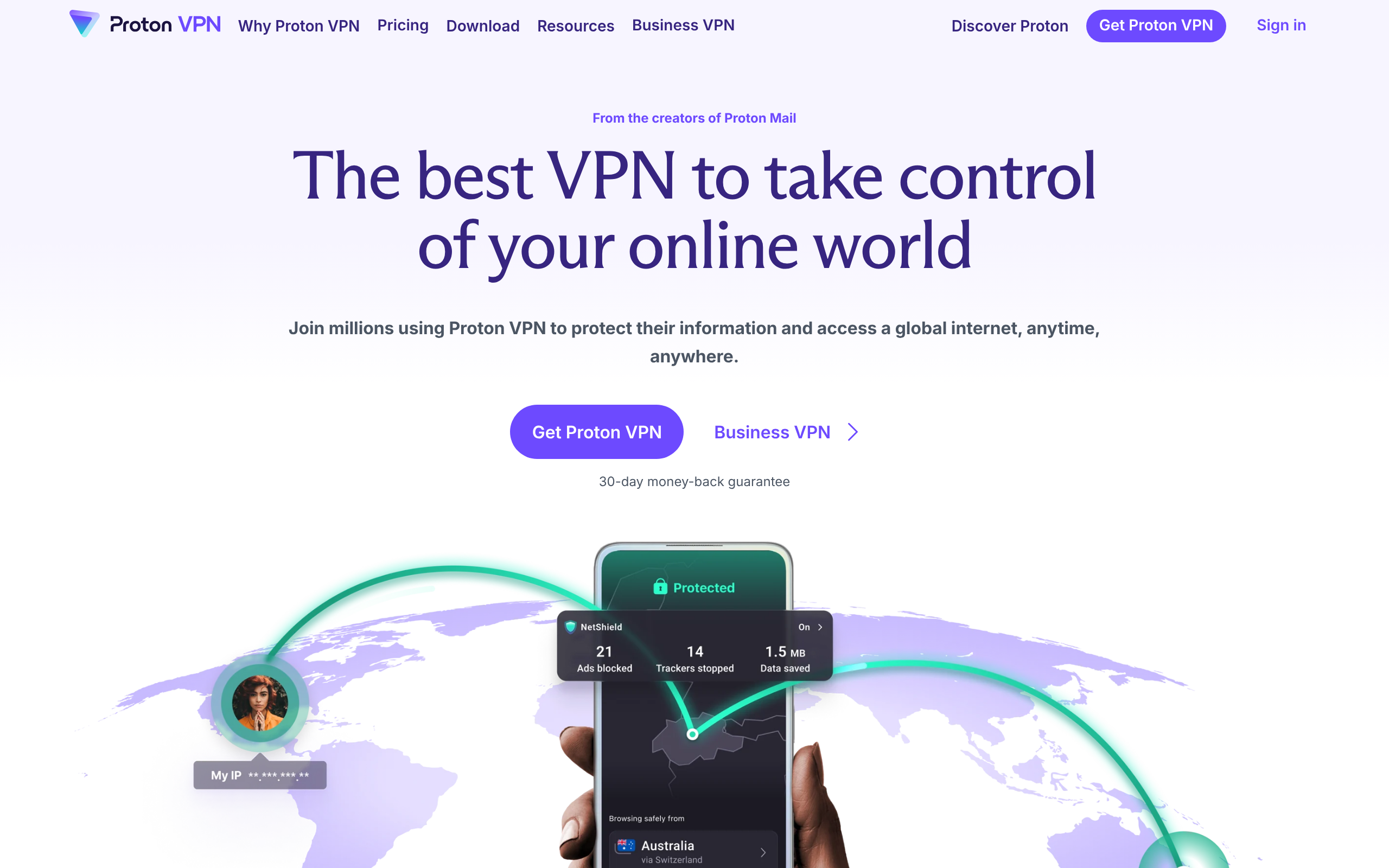
- NetShield Ad-blocker: DNS-level filtering that blocks ads, trackers, and malicious domains before they reach your device.
- VPN Accelerator: A proprietary set of technologies that boosts VPN speeds by up to 400% over long distances.
- Secure Core: A double-VPN architecture that routes traffic through multiple privacy-friendly countries (Switzerland, Iceland, Sweden) to defend against network-based attacks.
- Stealth protocol: An obfuscated VPN protocol that bypasses sophisticated censorship and VPN blocking.
- Kill switch & Always-on VPN: Prevents IP exposure if the connection drops, with automatic reconnection.
- Tor over VPN: Route traffic through the Tor anonymity network with a single click.
- Split tunneling: Choose which apps or IPs use the VPN tunnel and which bypass it.
- Port forwarding: Improve P2P performance and access local resources through the VPN.
Platform Support
ProtonVPN provides native apps for Windows, macOS, Linux, Android, iOS/iPadOS, Android TV, Apple TV, Chromebook, and browser extensions for Chrome and Firefox. A single paid subscription covers up to 10 simultaneous device connections.
Use Cases
- Privacy protection: Hide your IP address and encrypt all internet traffic from ISPs and advertisers.
- Bypassing censorship: Access blocked content and websites in restrictive regions using Stealth and alternative routing.
- Streaming: Unblock geo-restricted content on Netflix, Hulu, Disney+, and other major streaming platforms.
- P2P file sharing: Optimized servers for secure torrenting with port forwarding support.
- Public WiFi security: Protect sensitive data on untrusted networks using strong encryption and kill switch protection.
Highlights
Pros
- Secure Core multi-hop architecture routes traffic through physically hardened data centers (including a former military base) in Switzerland, Iceland, and Sweden — an unmatched level of physical server security.
- Successfully unblocks 6+ Netflix regional libraries (US, UK, Canada, Japan, Australia, Egypt), BBC iPlayer, Disney+, HBO Max, Hulu, and Amazon Prime Video across multiple testing locations.
- All apps are fully open-source and have been independently audited multiple times, with the no-logs policy verified by Securitum annually since 2022.
- Offers a rare Linux graphical user interface (GUI) app alongside native apps for Windows, macOS, Android, iOS, Android TV, and Apple TV — providing near-full feature parity across platforms.
- Proprietary VPN Accelerator technology boosts speeds by up to 400%, delivering an average download speed loss of only 12–16% in third-party tests — among the fastest VPNs tested.
- Headquartered in Switzerland, outside the 5/9/14 Eyes surveillance alliances, giving users protection from some of the strongest data privacy laws in the world.
Cons
- On macOS, the kill switch does not fully protect the public IP address when switching between servers — a gap that is not clearly communicated to users before they change servers.
- About two-thirds of server locations are virtual rather than physical, meaning the server hardware is not located in the advertised country — which can increase latency on those connections.
- OpenVPN speeds significantly trail competitors (449 Mbps vs 1,038 Mbps from ExpressVPN and 825 Mbps from Surfshark in TechRadar testing), and OpenVPN is not available on macOS, iOS, or Android native apps.
- Live chat support is not available 24/7 — only operates from 9:00 AM to 12:00 AM CET, leaving several hours without real-time assistance for users outside Europe.
- Split tunneling cannot be used simultaneously with the kill switch on Windows, forcing users to choose between these two important security features.
- NetShield ad-blocking interferes with some ad-funded streaming services (e.g., Channel 4), requiring users to manually disable it to access certain regional content.