

Description
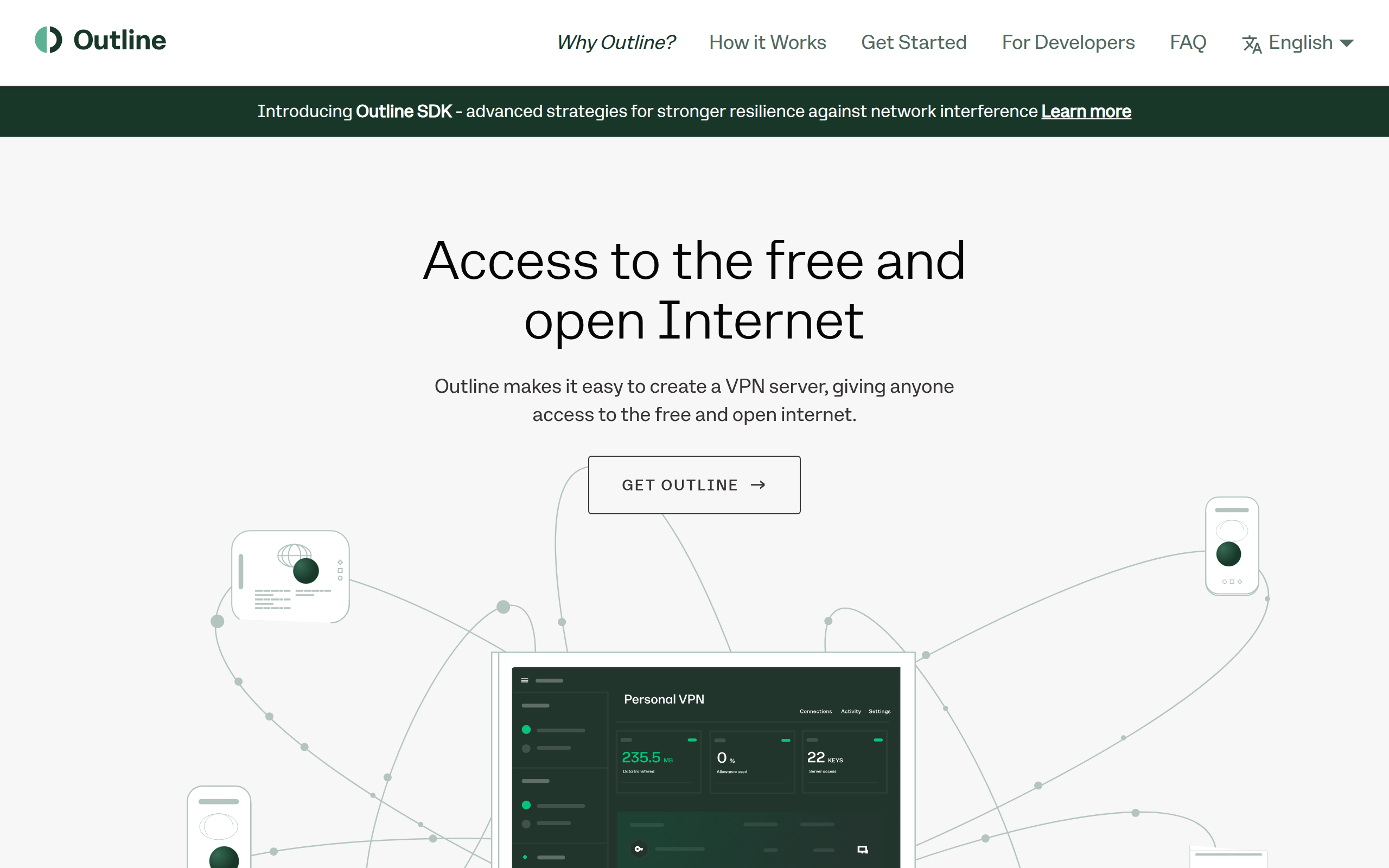
Outline VPN is a free, open-source toolset that lets anyone create, run, and share their own VPN server. Developed by Jigsaw (a Google incubator) and now owned by the non-profit Outline Foundation, it is designed to give users control over their internet privacy while resisting sophisticated censorship.
Key Features
- Blocking Resistant: Resistant to DNS, content, and IP blocking — works even when other VPNs are blocked.
- Full Control: Choose your server location from trusted cloud providers and manage who has access.
- Access Keys: Generate unique keys from the Outline Manager to share with your network. Set data limits per user.
- Open Source & Audited: Code audited by Radically Open Security and Cure53.
- Cross-Platform: Available on Windows, macOS, Linux, Android, iOS, and Chrome.
Two Products
- Outline Manager — Desktop app to set up and manage your VPN server.
- Outline Client — App to connect your devices using a unique access key.
For Developers
Outline SDK provides advanced networking strategies, including Shadowsocks-based proxies, fragmentation, and resilient DNS, for building censorship-resilient applications across all major platforms.
Highlights
Pros
- No activity logs collected and no registration or personal information required to use the client
- Fully open-source with code audited by two independent security firms — Radically Open Security (2018, 2022) and Cure53 (2018, 2024)
- Full control over server location, access key creation and revocation, data limits per user, and easy server deletion and recreation
- VPN server can be deployed in about eight minutes from download to connection, with no command-line skills required
- Owned by the independent non-profit Outline Foundation, originally launched by Jigsaw (a Google incubator)
- Designed to resist DNS, content, and IP blocking using the Shadowsocks protocol with obfuscation, domain fronting, and rotating port numbers
Cons
- Requires users to set up and maintain their own cloud server infrastructure, which adds ongoing operational overhead
- Initial speed tests showed a significant drop in both download and upload throughput compared to baseline connections
- Limited first-party client support — no native macOS Manager or iOS client, requiring manual configuration on those platforms
- Default DigitalOcean integration limits server locations to approximately eight cities, far fewer than commercial VPNs
- Self-hosted servers make individual traffic patterns more attributable compared to large shared-server VPNs where users share a single IP
- On Windows, Outline does not yet work as a full system VPN, so not all applications and traffic are encrypted