

Description
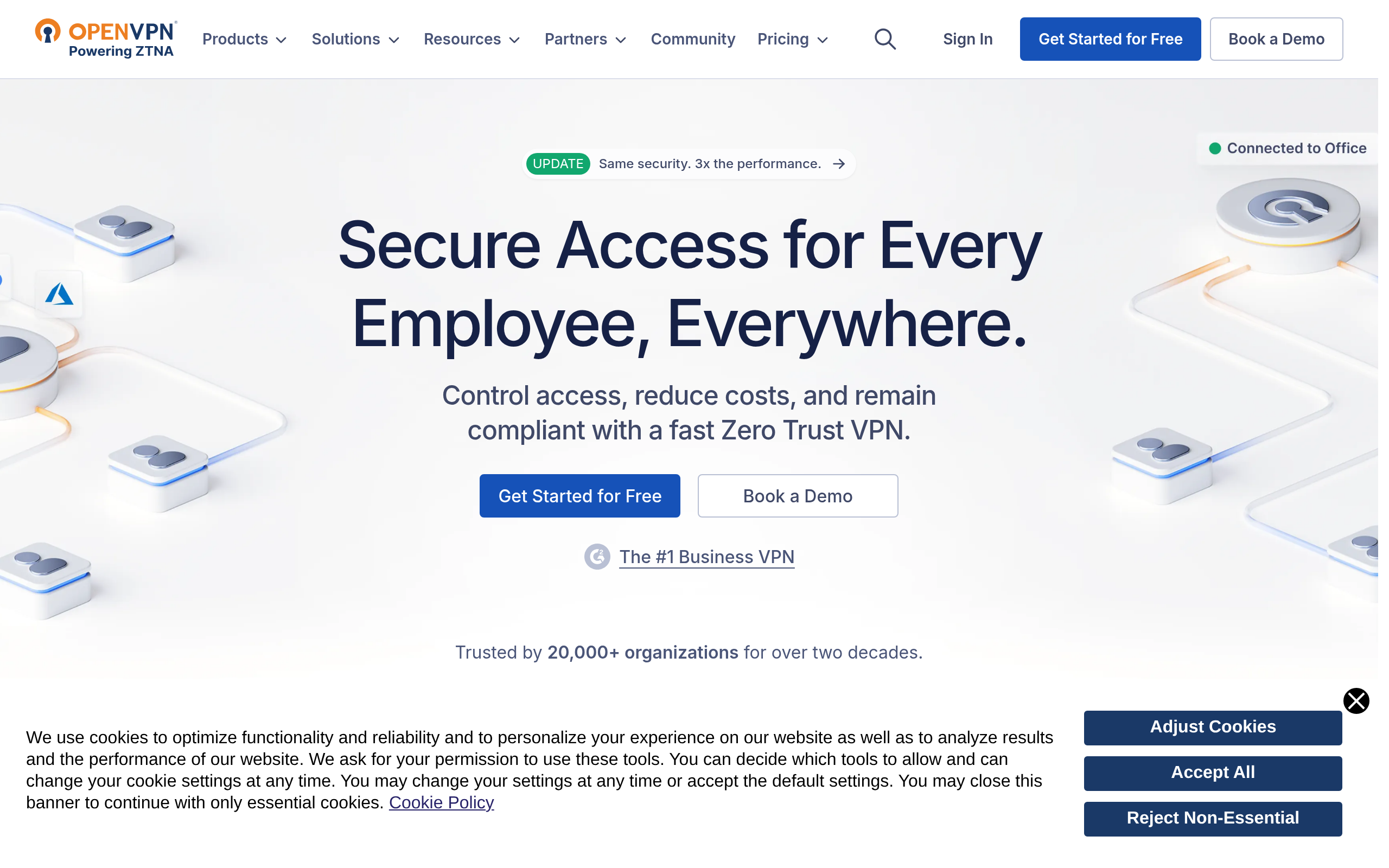
OpenVPN is a business VPN platform trusted by over 20,000 organizations worldwide, including Fortune 500 companies. It enables secure encrypted remote access to corporate networks through two deployment models.
Two Deployment Options
- Access Server — Self-hosted VPN deployed on Linux, cloud providers (AWS, Azure, GCP, DigitalOcean, Oracle Cloud, IBM Cloud), Docker, Hyper-V, or VMware ESXi. Complete control over security architecture and access policies.
- CloudConnexa® — Cloud-delivered managed VPN service connecting applications, private networks, workforce devices, and IoT endpoints without self-managed server software.
Key Features
- Zero-trust controls — Enforce access policies based on identity, device, and location context
- Multi-factor authentication — TOTP, PAM, RADIUS, LDAP, and SAML support
- Kernel acceleration — OpenVPN DCO delivers near wire-speed performance with multi-threaded encryption
- Clustering — Auto-failover and load balancing across multiple servers
- Cross-platform clients — OpenVPN Connect for Windows, macOS, Linux, Android, iOS, and ChromeOS
Use Cases
Secure remote access for hybrid employees, site-to-site VPN, IoT communications, SaaS application protection, and zero-trust network access (ZTNA).
Compliance
SOC 2 Type 2, ISO/IEC 27001:2022, HIPAA, and GDPR compliant — suitable for healthcare, financial services, and technology industries.
Highlights
Pros
- Data Channel Offload (DCO) delivers kernel-accelerated, multi-threaded encryption that boosts VPN throughput by up to 3x over standard software-based processing.
- Cross-platform client support covers Windows, macOS, Linux, Android, iOS, and ChromeOS with a self-service user portal that streamlines onboarding and client distribution.
- Supports multiple simultaneous authentication methods including LDAP, RADIUS, SAML SSO, and TOTP, enabling integration with existing identity providers and zero-trust policies.
- Offers both self-hosted (Access Server) and fully managed cloud (CloudConnexa) deployment options, giving organizations flexibility to control their own security architecture or go serverless.
- Holds SOC 2 Type 2, ISO/IEC 27001:2022, HIPAA, and GDPR compliance certifications, making it suitable for regulated industries such as healthcare, finance, and government.
- Trusted by over 20,000 organizations including Fortune 500 companies and ranked the #1 Business VPN on G2 with 96% of reviewers willing to recommend it.
Cons
- Some users report occasional connectivity drops that require reconnecting, though the core VPN remains generally stable once the initial configuration is correct.
- Some administrative tasks require logging into the server to run CLI commands instead of being available through the web UI, adding complexity for less technical admins.
- Scaling infrastructure can cause license provisioning issues that require contacting support to resolve, adding friction during growth or reconfiguration.
- The admin web interface is described by some users as unintuitive and lacking the polish of competing solutions for certain configuration and management workflows.
- Connection speed is slower than newer protocols like WireGuard, a frequently cited drawback by reviewers who note WireGuard offers noticeably faster performance.