

Description
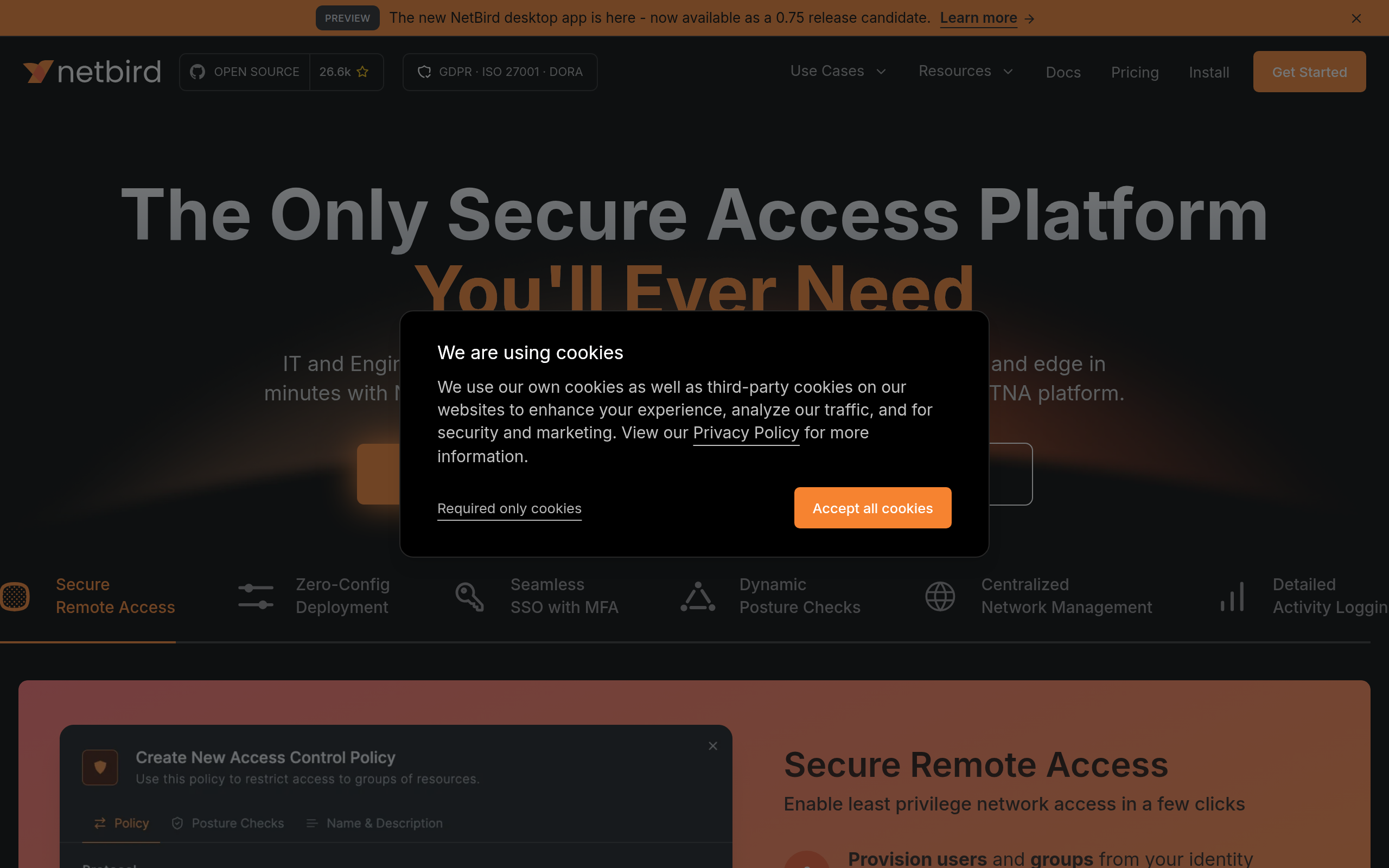
NetBird combines a WireGuard-based overlay network with Zero Trust Network Access (ZTNA) into a single, easy-to-deploy platform. It gives IT and engineering teams secure, granular connectivity across any infrastructure — cloud, on-premises, or edge — without the complexity of legacy VPNs.
Key Features
- Identity-Based Access Control — Define granular network policies that restrict access by user, group, and device, implementing least-privilege principles.
- SSO with MFA — Integrate with identity providers (OpenID, Entra ID) and enforce multi-factor authentication for every connection.
- Dynamic Posture Checks — Verify device security compliance (e.g., Defender for Endpoint) before granting network access.
- Centralized Network Management — Manage all connections, users, and policies from a single dashboard with detailed activity logging.
- Automated Peer-to-Peer Connectivity — Direct WireGuard tunnels between peers eliminate single points of failure and reduce latency.
- Infrastructure-Agnostic — Runs on Linux, Windows, macOS, iOS, Android, Docker containers, and routers; connects resources across any cloud or on-prem environment.
Open Source & Self-Hosted
NetBird is distributed under a permissive BSD-3 license and can be self-hosted on your own infrastructure, giving teams full control over their data and network. A managed cloud option (NetBird Cloud) is also available for teams that prefer a fully-hosted solution.
Common Use Cases
- Secure remote access for distributed and hybrid workforces
- Multi-cloud and hybrid-cloud connectivity
- Edge device and IoT network management
- MSP secure access to client environments
- Replacing legacy VPN and SSL VPN infrastructure
Highlights
Pros
- Based in Berlin, Germany with cloud infrastructure hosted in Germany — fully GDPR compliant, no exposure to US CLOUD Act, and zero traffic content inspection by the control plane.
- WireGuard-based peer-to-peer mesh architecture with automatic NAT traversal — traffic flows directly between peers without a central gateway, reducing latency and eliminating single points of failure.
- Fully open-source under BSD-3 license with complete self-hosting capability — the entire control plane (management, signal, and relay) can run on your own infrastructure with no user caps or feature restrictions.
- Zero-trust access controls with SSO (Okta, Azure AD, JumpCloud, Google), MFA enforcement, and dynamic device posture checks (OS version, firewall, disk encryption) — enforcing least-privilege at the network layer.
- Integrates with SIEM tools (Splunk, Datadog), offers REST API, Terraform support, and service accounts for CI/CD pipelines — enabling automated infrastructure and audit trail compliance.
Cons
- Android client can exhibit higher battery drain compared to competing solutions and may drop connections when roaming between networks, per user reports.
- DNS resolution failures are a commonly reported issue — the client modifies resolv.conf and can break DNS when switching networks or roaming, with no clear troubleshooting pattern across affected users.
- Self-hosting requires familiarity with Docker, DNS configuration, and reverse proxy setup — despite the unified server binary (v0.65), the initial deployment is not zero-effort for non-infrastructure teams.
- Windows and iOS clients are less mature than the macOS and Linux counterparts — the iOS app is not available on F-Droid and some enterprise features require manual configuration workarounds.
- No native support for consumer use cases like geo-unblocking streaming services — NetBird is purpose-built for infrastructure and team access, not consumer privacy browsing.