

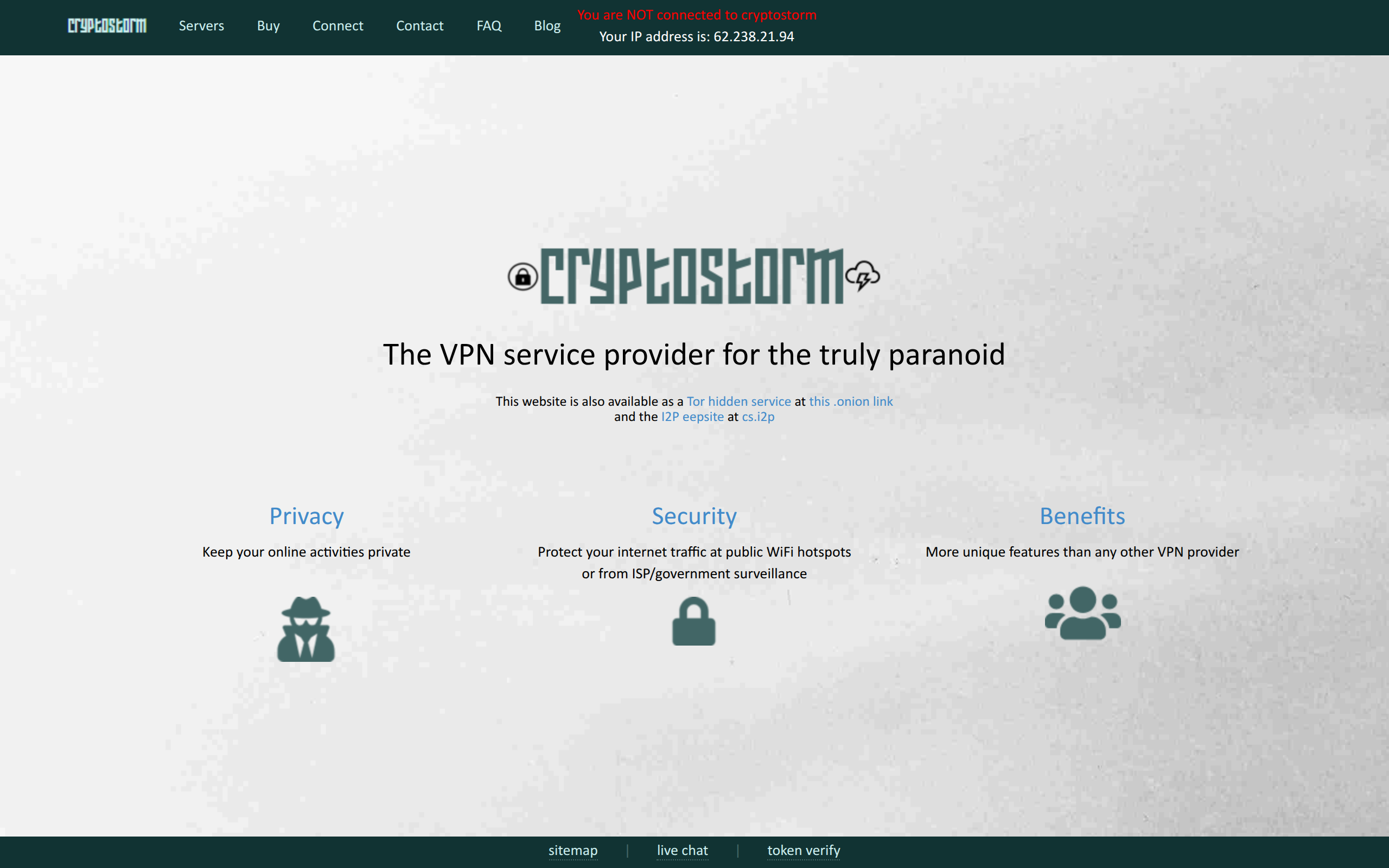
Description
Cryptostorm is a VPN service built for users who demand uncompromising privacy, security, and transparency. Operating since 2010, it runs exclusively on bare-metal dedicated servers with a verifiable no-logs policy — no connection timestamps, source IPs, or destination IPs are ever recorded.
Protocols & Cryptography
- OpenVPN ECC — Ed25519, Ed448, secp521r1, and ML-DSA-87 (post-quantum) instances with TLSv1.3 and 256-bit AES or ChaCha20-Poly1305
- OpenVPN RSA — 8192-bit server certificates, 521-bit EC CA, 8192-bit DH params
- WireGuard — Curve25519 ECDH, ChaCha20-Poly1305, BLAKE2s hashing
Privacy & Authentication
- Token-based anonymous access — plaintext tokens are never stored on authentication servers; only SHA-512 hashes are used for verification
- No identifying logs — authentication database stores only an activated_at timestamp, duration, token hash, and session count
- Decentralized organization — no central HQ, entities in multiple regions, staff outside those jurisdictions
Advanced Features
- Server-side multihop — seamlessly chain connections between endpoints on the network
- Client-side multihop — connect through another VPN or Tor before reaching Cryptostorm
- DeepDNS — encrypted DNS via DNSCrypt v2, Anonymized DNS, and DNS-over-HTTPS
- Obfuscation — Xray (VLESS+REALITY), SSH tunneling, stunnel (HTTPS), and obfs4 to bypass restrictive firewalls
- Connect on any port (1–65535) over UDP or TCP
- Built-in kill switch, DNS/WebRTC leak protection, and ad/tracker blocking
- Transparent .onion and .i2p access
- Port forwarding and BitTorrent allowed
- 450+ exit IPs with IPv6 support, no bandwidth caps or throttling
Ideal For
Journalists, activists, privacy researchers, and everyday users who need strong anonymity, censorship circumvention, and protection from ISP or government surveillance — backed by fully open-source server configurations and a transparent security model.
Highlights
Pros
- Implements post-quantum cryptography (ML-DSA-87) in its OpenVPN ECC instances, making it one of the few VPNs to offer quantum-resistant encryption.
- Supports server-side multihop chaining to seamlessly route traffic between multiple endpoints without additional client configuration beyond a single connection file.
- Uses a token-based anonymous authentication system where plaintext tokens are never stored; only SHA-512 hashes are used for verification, preventing identification even if servers are compromised.
- Offers six obfuscation methods including Xray (VLESS+REALITY), SSH tunneling, stunnel over HTTPS, and obfs4 for bypassing restrictive firewalls and deep packet inspection.
- All server-side configurations are published as open source for public review, enabling independent verification of backend security claims.
- Provides a built-in DeepDNS system with DNSCrypt v2, Anonymized DNS, and DNS-over-HTTPS that encrypts DNS queries before the VPN connection is even established.
Cons
- Speed tests from multiple independent reviewers show 85–99% download speed drops even on nearby servers, making high-bandwidth activities like streaming or large downloads impractical.
- Server network is limited to approximately 49 servers across 28 countries concentrated in Europe and North America, with no presence in South America, Africa, or Oceania.
- Failed to unblock Hulu, HBO Max, BBC iPlayer, Disney+, and Amazon Prime Video in multiple independent tests, with only Netflix reliably accessible.
- Third-party testers have reported that enabling the built-in DNS leak protection causes a DNS_PROBE_FINISHED_BAD_CONFIG error, preventing internet access entirely.
- Only offers a native Windows application; all other platforms (macOS, Linux, iOS, Android) require manual configuration through third-party OpenVPN or WireGuard clients.
- The company behind the service (Baneki Privacy Computing Inc.) is registered in Canada, a Five Eyes alliance member, despite using an Icelandic .is domain and claiming Icelandic roots.