

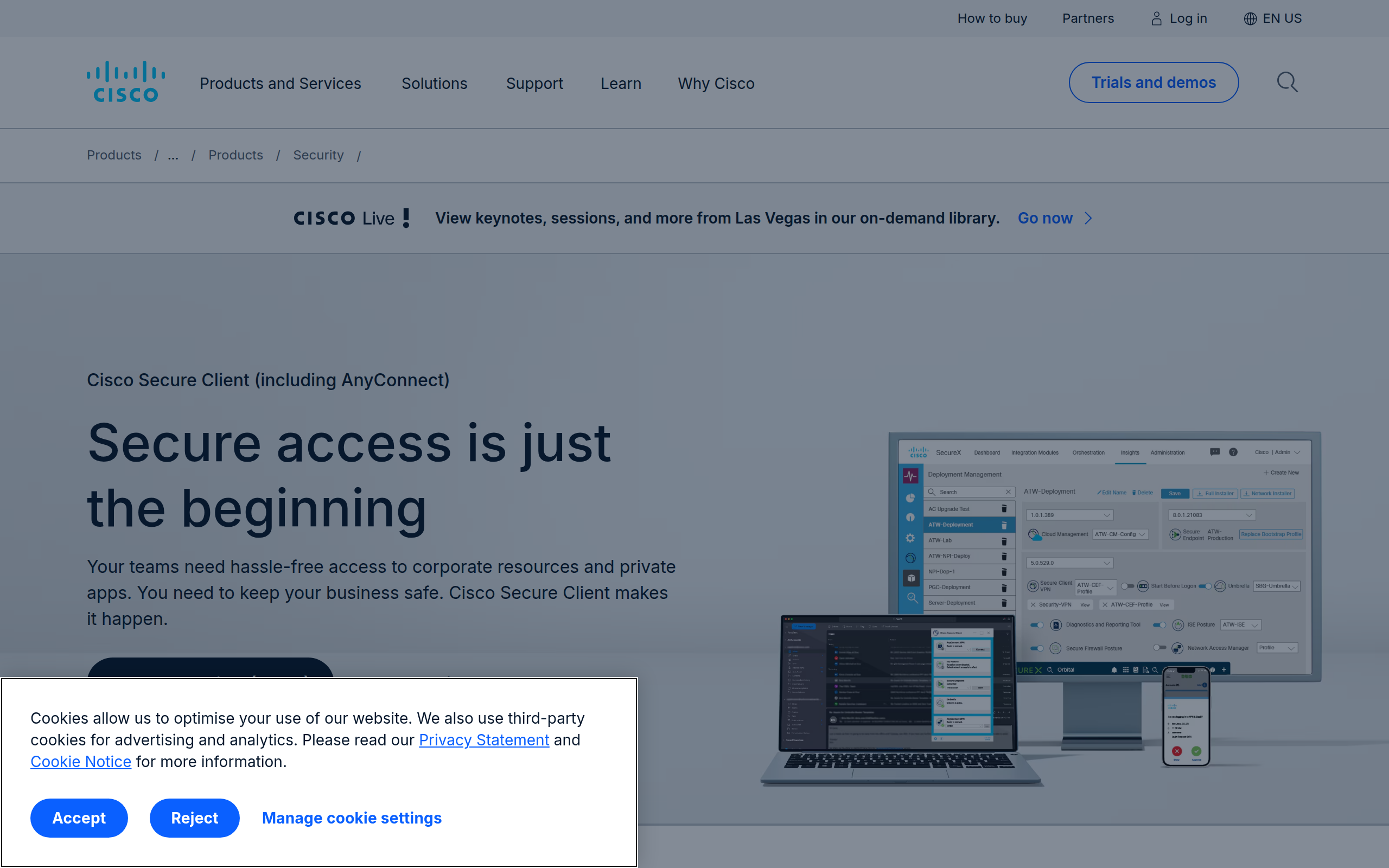
Cisco Secure Client (AnyConnect) is the next-generation evolution of the widely deployed AnyConnect VPN client, now enhanced with a modular architecture for comprehensive endpoint security.
Key capabilities include:
-
VPN/ZTNA Access — Delivers fast, policy-compliant remote connectivity to corporate networks and private apps with support for multi-factor authentication.
-
Unified Cloud Management — A single cloud-based management console lets IT teams deploy, configure, and monitor all endpoint security agents across the entire fleet from one screen.
-
Modular Security Agents:
- Cisco Secure Endpoint module — Advanced endpoint protection across all control points
- Cisco Umbrella Roaming module — Cloud-delivered security that protects users even when they are off the VPN
-
Network Visibility — When paired with Cisco Secure Network Analytics, monitors endpoint application usage and user behavior for deeper operational insights.
-
Threat Detection Integration — Works with Cisco XDR to detect sophisticated threats across all vectors and prioritize incidents by impact for faster response.
Secure Client helps IT and security professionals deliver seamless, hassle-free access to corporate resources while maintaining a strong security posture across the distributed workforce.
Pros
- Integrates natively with Cisco Duo for multi-factor authentication via RADIUS or SAML protocols, enhancing access security
- Unified modular agent combines VPN/ZTNA, Cisco Secure Endpoint, and Cisco Umbrella Roaming into a single deployable client managed from one console
- Provides endpoint application usage monitoring and user behavior insights when paired with Cisco Secure Network Analytics
- One-click VPN connectivity delivers reliable, stable remote access that users describe as "never fails" and feels like sitting at the office desk
- Cross-platform support across Windows, macOS, and Linux enables consistent secure access across diverse endpoint environments
Cons
- Operating system updates (Windows and macOS) can break connectivity, requiring additional troubleshooting and reconfiguration
- User interface and overall design feel dated compared to modern VPN clients, with reviewers calling for a visual refresh
- Lacks a built-in kill switch to automatically block traffic when the VPN connection drops unexpectedly
- Linux client build lags behind Windows and macOS versions in feature parity and update frequency
- Fully automated deployments are difficult to set up, making large-scale rollouts more complex than competing solutions